Sa 1, Sa 2, Sa 2½ and Sa 3 Explained
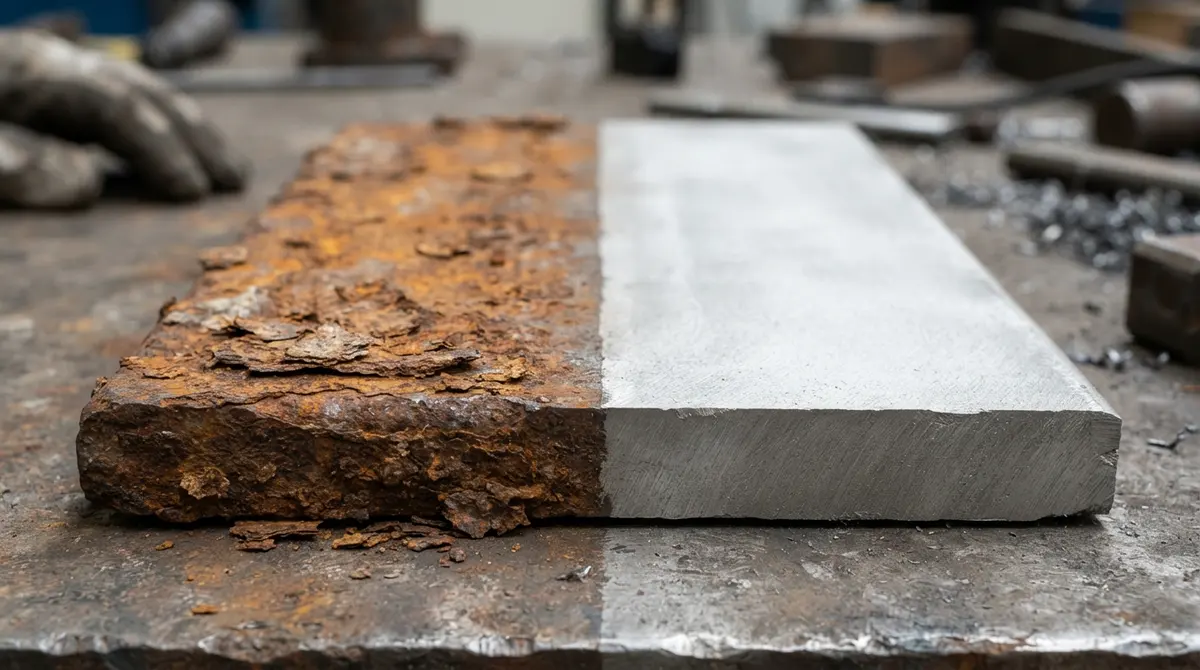
ISO 8501-1 grades the cleanliness of a steel surface after abrasive blasting. The designation "Sa" stands for blast cleaning, and the number indicates how much mill scale, rust and old coating remains.
The grade is judged visually, against the photographs in the standard. It describes cleanliness only and does not describe the roughness of the surface, which is measured separately.
- Sa 1, light blast cleaning: loose mill scale, loose rust and loose paint are removed, although tightly adherent scale and rust may remain.
- Sa 2, thorough blast cleaning: almost all mill scale, rust and old coating are removed, and what remains is firmly bonded to the steel.
- Sa 2½, very thorough blast cleaning: all mill scale, rust and coating are removed, and only slight shadows, streaks or stains remain, on up to 5% of the surface.
- Sa 3, blast cleaning to visually clean steel: no scale, rust or coating is visible, and the surface has a uniform metallic colour.
Sa 2½ is the grade that most specifications require before metallizing and high-performance paint. It is clean enough for the coating to adhere securely, and it is considerably more economical to achieve than Sa 3.
SSPC, NACE, SIS and ISO Equivalents
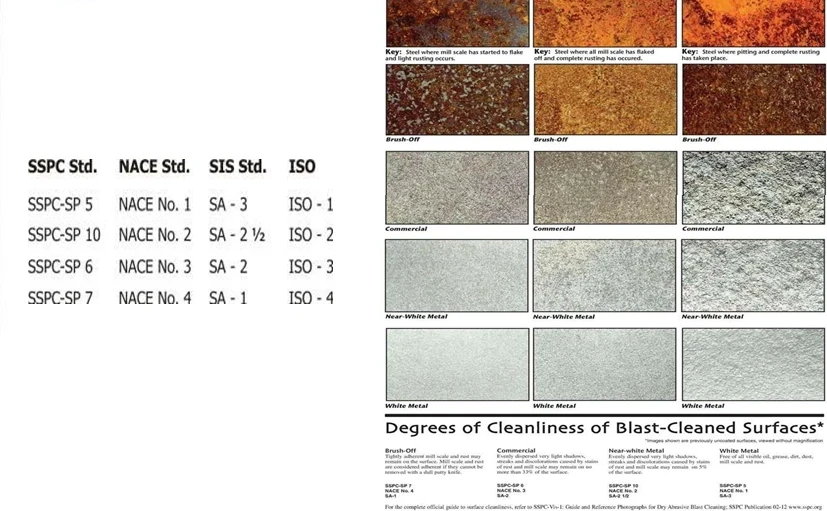
Specifications from different countries use different designations for the same four degrees of cleanliness. The table lists the usual equivalents.
| ISO 8501-1 / SIS 05 59 00 | SSPC | NACE | Common name |
|---|---|---|---|
| Sa 1 | SSPC-SP 7 | NACE No. 4 | Brush-off blast |
| Sa 2 | SSPC-SP 6 | NACE No. 3 | Commercial blast |
| Sa 2½ | SSPC-SP 10 | NACE No. 2 | Near-white metal |
| Sa 3 | SSPC-SP 5 | NACE No. 1 | White metal |
The correspondence is close but not exact. SSPC-SP 6, for example, allows staining on up to a third of each unit area. Where a contract names a particular standard, the work is carried out and inspected to that standard.
Rust Grades A to D
ISO 8501-1 also grades the steel before blasting. The starting condition affects the time that blasting requires and the cleanliness that can be achieved.
- Grade A: steel covered with adherent mill scale, with little or no rust.
- Grade B: steel that has begun to rust, with mill scale starting to flake.
- Grade C: mill scale has rusted away or can be scraped off. Slight pitting is visible.
- Grade D: mill scale has rusted away and general pitting is visible.
The rust grade and blast grade are written together, for example "C Sa 2½". Pitted steel (grades C and D) retains salts and moisture in the pits, and it requires more blasting time, and sometimes a wash, to reach the same grade.
Before blasting a structure, we record its starting grade and agree the target grade with the client. Rust on a plant that has operated for many years is nearly always grade C or D.
Selecting the Grade for Each Coating
The coating determines the grade, and not the reverse. Thermal spray metal requires bare, clean steel, because it bonds mechanically to the blast profile, whereas paint can be more tolerant.
| Coating | Usual grade | Note |
|---|---|---|
| Thermal spray zinc | Sa 2½ or Sa 3 | Sa 2½ is our standard before metallizing |
| Thermal spray aluminium | Sa 3, or Sa 2½ where specified | Aggressive and high-temperature service |
| High-performance paint (epoxy, polyurethane) | Sa 2½ | Common in plant and marine specifications |
| General industrial paint | Sa 2 | Less demanding environments |
| Light maintenance painting | Sa 1 | Sound existing coating, loose scale only |
The paint data sheet or the coating specification should always be followed. Where none is available, we recommend a grade suited to the service environment.
Surface Profile and Cleanliness
Blasting also roughens the steel into peaks and valleys. This is the surface profile, or anchor pattern, into which the coating locks. A steel surface can be clean to Sa 2½ and still have an unsuitable profile.
The profile depends on the abrasive. Mythri Metallizing uses steel grit, copper slag and aluminium oxide, and selects the abrasive and its size to produce the profile that the coating specification requires. Thermal spray metal requires a sharp, angular profile.
Profile height is measured in micrometres (µm). Specifications usually give a range: if the profile is too shallow the coating may peel, and if it is too deep the peaks may show through thin paint. The range should be taken from the coating specification or data sheet.
How We Verify the Blast Grade
We check every blasted surface before any coating is applied. The checks are the same at our facilities in Bengaluru and at your site.
- Visual comparison of the blasted steel with the ISO 8501-1 reference photographs, in good light.
- Surface profile measurement with a profile gauge.
- Inspection of the surface for dust and spent abrasive, and for oil or grease.
- Measurement of air and steel temperature, humidity and dew point, because blasted steel flash-rusts quickly in damp air.
The blast grade and profile are entered in the project record and the test report. Coating begins on the same day, before the steel can rust again.