Thermal Spray Zinc Coating Services

Zinc metallizing gives structural steel the sacrificial protection of galvanizing, without the bath, the heat or the size limitation.

  • IS 5905 · IS 6586 · BS 5493
  • 175–200 µm standard
  • Zinc and zinc-aluminium 85/15
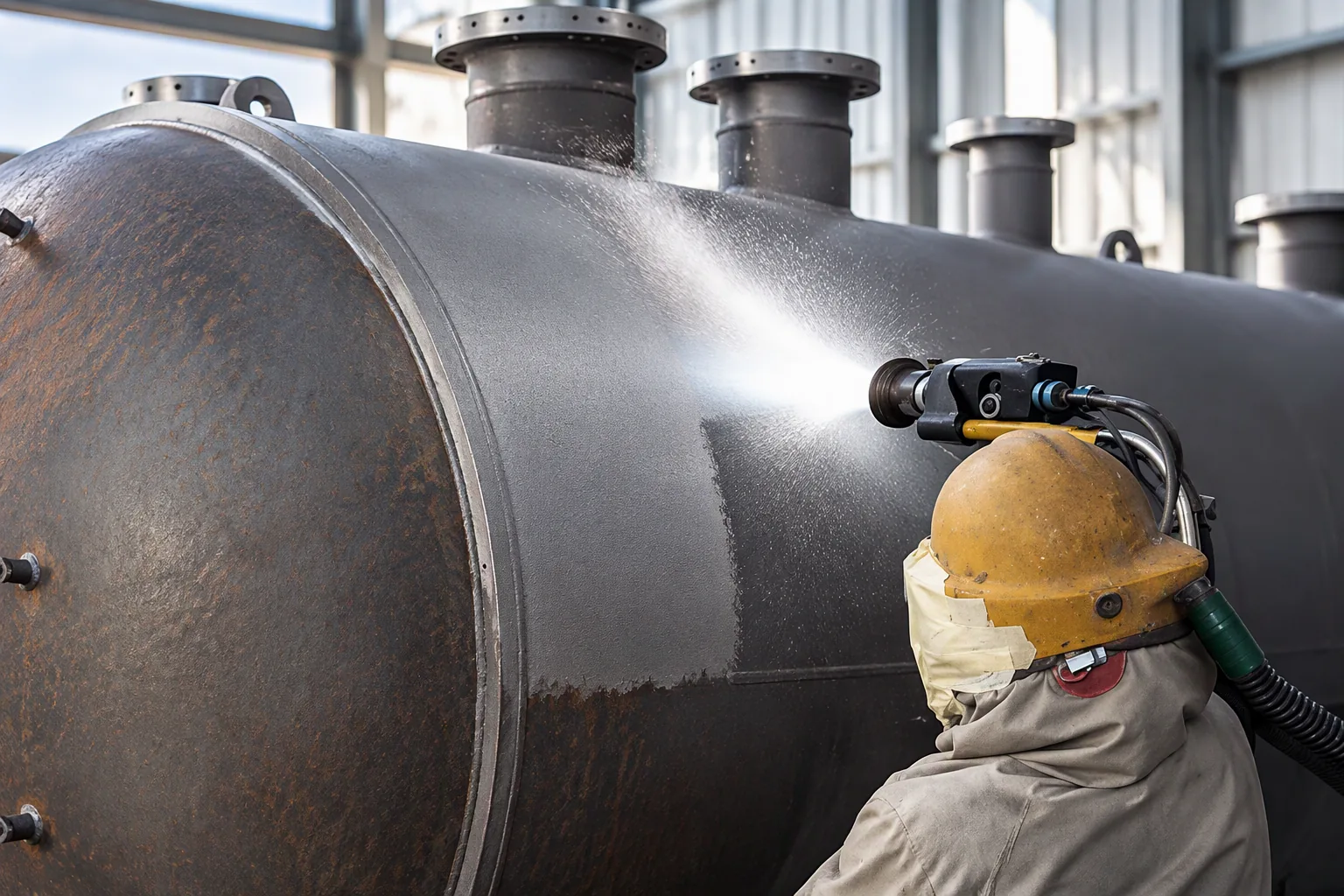
Operator in a hood and helmet arc spraying metal onto a large blasted steel vessel

How Thermal Spray Zinc Protects Steel

In thermal spray zinc coating, also known as spray galvanizing or zinc metallizing, zinc wire is melted in an electric arc or a flame and atomised by compressed air onto steel that has just been abrasive blasted. The droplets flatten and lock into the blast profile, building a dense zinc layer pass by pass.

Zinc is anodic to steel. Where the coating is scratched or cut, the zinc corrodes first and protects the exposed steel around it. This is the same electrochemical protection that hot-dip galvanizing provides, applied cold and at any size.

Mythri Metallizing has applied zinc and zinc-aluminium coatings since 1999, on fabrications at our Peenya and Dabaspet units and on structures at client sites.

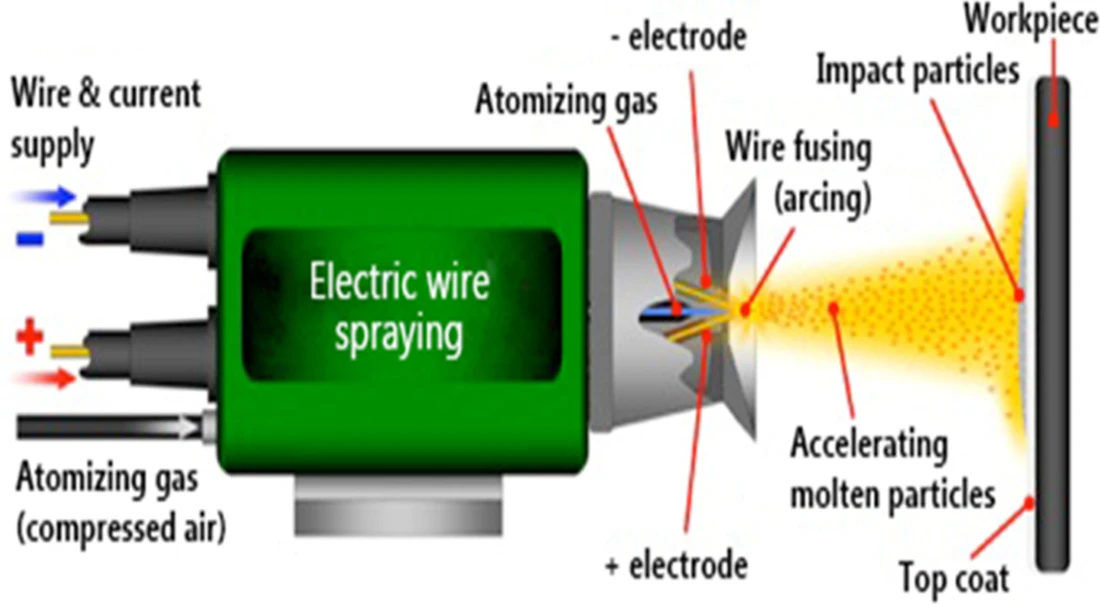
Diagram of an arc spray gun: two charged wires meet and arc at the nozzle, and compressed air atomises the molten metal and carries it onto the workpiece as a coating
Zinc wire is melted in the electric arc and propelled onto the blasted steel. Zinc may also be applied by flame spray, in which the wire is melted in a gas flame instead.

When to Specify Thermal Spray Zinc

Structures Too Large for a Galvanizing Bath

Long girders, tanks, towers and plant structures that cannot be accommodated in a hot-dip kettle can be sprayed in one piece.

Components Liable to Distort in Hot-Dip Galvanizing

The steel remains cool during spraying, so thin sections and welded fabrications retain their shape and tolerances.

Structures Already Installed

Our teams blast and spray in situ, which allows a structure to be protected without being dismantled.

Steel to Be Painted Afterwards

A sealed zinc coating provides an excellent base for paint and extends the life of the paint system applied over it.

Specification

Thickness, sealer and any paint system are agreed for each project on the basis of the service environment and the design life.

Surface preparation
Abrasive blast to ISO 8501-1 Sa 2½ or Sa 3, with a sharp anchor profile
Coating material
Zinc wire, 99.95% purity to IS 209, or zinc-aluminium alloy 85/15
Application
Electric arc or flame spray, within hours of blasting
Standard thickness
175–200 µm, measured before release; up to 500 µm possible
Standards
IS 5905 · IS 6586 · BS 5493
Thickness test
Calibrated gauge with test pieces, to IS 3203
Adhesion tests
Pull-off to ASTM D4541 and scribe test to IS 5905
Sealer
Applied over the zinc to close porosity and smooth the surface
Where
At our facilities in Bengaluru or at your site

Our Application Procedure

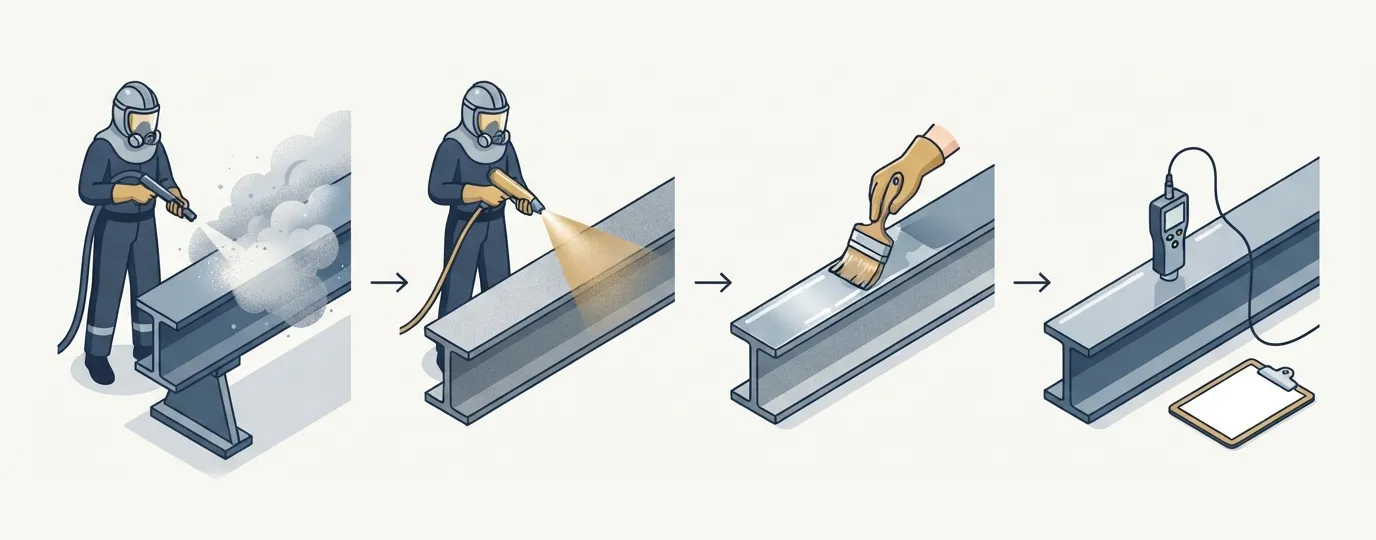
Diagram in four stages: the steel is blasted, zinc is arc sprayed onto it, a sealer is brushed on, and the coating thickness is measured
Why It MattersZinc protects steel by corroding in its place. Blasting gives the zinc grip, and sealing slows its wear. Illustrative diagram.
  1. Blast

    Compressed-air abrasive blasting removes rust, mill scale and old coatings, and leaves the profile that the zinc requires for a secure bond.

  2. Spray

    Zinc wire is melted and atomised onto the fresh surface in overlapping passes until the specified thickness has been built.

  3. Seal

    A sealer fills the pores in the sprayed layer, slows the rate at which the zinc is consumed and keeps the surface easy to clean.

  4. Test and Record

    Thickness is gauged across the surface and adhesion is tested. The results are entered in the project record and the test certificate.

Applications

Thermal spray zinc protects steel in most atmospheres and in contact with many natural and industrial substances. We apply it for chemical, fertiliser, refinery, cement and power plants, and on buildings, bridges and pipelines.

  • Structural steel and building frames
  • Transformer tanks and radiators
  • Communication and wind-mill towers
  • Steel storage tanks
  • Electric poles, gates and grilles
  • Gutters and structures in chemical plants
  • Dairy coils
  • Bridges and pipelines

Recent Projects

Essar Projects, Hazira, Gujarat

Zinc metallizing · 100 days · team of 20

Zinc metallizing was carried out on a coarse screen project at a power plant. Essar recorded that the work was completed within schedule and that the quality of workmanship was excellent.
Frequently Asked Questions

How does thermal spray zinc differ from hot-dip galvanizing?
Both protect steel with zinc. Hot-dip galvanizing immerses the part in molten zinc, so it is limited by the size of the bath and heats the steel. Thermal spray zinc is applied cold with a spray gun, so there is no size limit and no heat distortion, and the work can be carried out on site.
What thickness do you apply?
Our standard is 175–200 µm, measured with a calibrated gauge before the project is released. Thicker coatings, up to about 500 µm, can be applied where the environment requires them.
Can the zinc coating be painted?
Yes. A sealed thermal spray zinc coating provides an excellent base for paint. Paint over metallizing is often specified for appearance or for additional life in aggressive environments, and we can apply the complete system.
Can zinc be sprayed at our site?
Yes. Our teams travel with blasting and arc spray equipment and work on structures in place, in addition to parts brought to our facilities in Bengaluru.
Do you provide test certificates?
Yes. Each project is tested for thickness and adhesion, and the results are recorded. On request, a certificate of zinc wire purity from an external laboratory can be provided with our test certificate.

Send a Drawing for a Metallizing Quote

Share the drawing, the coating you need (zinc or aluminium, and the thickness) and where the steel is. One of our engineers will reply with the method and a quotation.

  • Reply within one working day
  • Drawings kept confidential
  • Email acknowledgement

Enquiry Details

Please enter your name.
Please enter a 10-digit mobile number or a landline number with STD code.
The email address appears incomplete. Please check for a missing @ symbol or domain.
Please select a service, or choose "Not sure, please advise".
Drawing or photographs

Thank you. Your enquiry has been received.

One of our engineers will contact you to discuss the requirement. A confirmation has been sent to your email address.